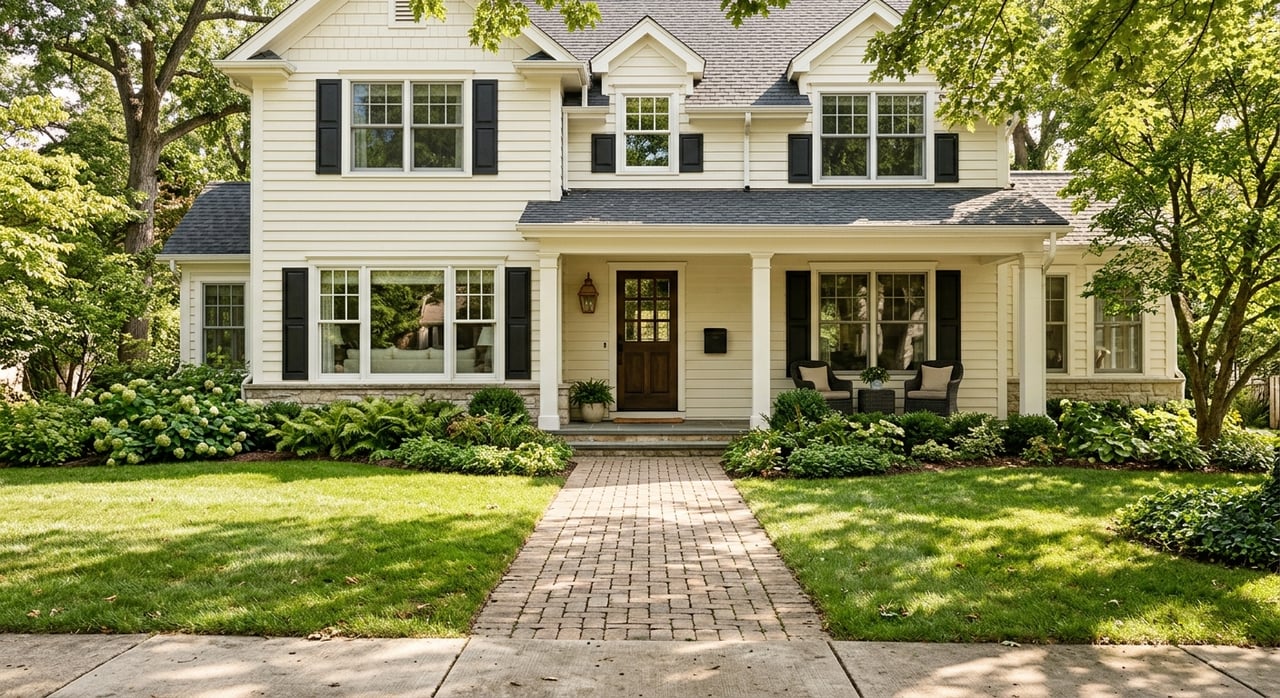
Oak Park vs River Forest: Which Village Fits Your Move?
May 28, 2026
May 28, 2026
Trying to choose between Oak Park and River Forest? You are not alone. These neighboring villages share a border, but they can feel very different once you start comparing housing, price points, walkability, and day-to-day lifestyle. If you want a clearer way to decide which one fits your budget and priorities, this guide will help you compare the tradeoffs with confidence. Let’s dive in.
Oak Park and River Forest are next to each other in western Cook County, but they are built at very different scales. Oak Park has about 54,500 residents in 4.5 square miles, while River Forest has about 11,489 residents in 2.48 square miles.
That size difference shapes a lot of what you will notice as a buyer. Oak Park tends to feel larger, denser, and more layered in terms of housing, business districts, and transit. River Forest tends to feel more residential, with commercial activity concentrated in a smaller number of areas.
If housing variety matters most to you, Oak Park usually gives you more to consider. Its zoning includes residential districts from R-1 through R-7, with minimum lot areas ranging from 10,000 square feet in R-1 down to 3,500 square feet in denser districts. Oak Park also allows accessory dwelling units on single-family residential properties.
That wider range often translates into more housing types and more price tiers. Depending on your search, you may find single-family homes, condos, townhomes, two-flats, and other mixed housing options that create more flexibility.
River Forest is more clearly oriented toward low-density residential living. Its zoning designates R1 as wide-lot single-family detached, R2 as single-family detached, R3 as attached single-family, and R4 as multi-family. A village zoning board document cites the R2 minimum lot area at 8,712 square feet, and the village comprehensive plan says single-family areas are the predominant land use.
In practical terms, River Forest often appeals to buyers who want a stronger single-family focus and a more spacious feel. Multi-family housing exists, but it is mainly located along major corridors rather than spread throughout the village.
For many buyers, this is where the decision becomes easier. If you want more compact lots and a broader mix of housing footprints, Oak Park may offer more options that line up with your goals.
If you are prioritizing a larger detached-house parcel and a lower-density setting, River Forest may be the better fit. The village’s zoning pattern supports that more spacious residential character, and that is one reason many buyers experience River Forest as quieter and more spread out.
Oak Park has the broader walkable commercial network. The village lists CTA Blue and Green Line stations, multiple CTA bus routes, several Pace routes, and Metra Union Pacific West service. It also promotes 12 business districts, including Downtown Oak Park, the Hemingway District, and the Oak Park Arts District.
That means your daily routine may be easier to manage without getting in the car every time. More errands, dining options, and transit stops are distributed across the village, which can make Oak Park feel more connected block to block.
River Forest offers walkability too, but it is more concentrated. The River Forest Metra station is located at 8001 W. Central Avenue on the Union Pacific West line, with Pace routes 309 and 313 connecting there. The village says Lake Street runs through the historic Village Center, while commercial uses cluster along North Avenue, Harlem Avenue, Lake Street, and Madison Street.
So if you want a walkable pocket rather than a broader village-wide network, River Forest may still work well. Its pedestrian activity is strongest around Lake Street, the station area, and the main commercial corridors.
Oak Park tends to offer a more layered mix of public amenities. The Park District lists 13 parks on 80 acres, along with two outdoor pools, an indoor ice rink, the Oak Park Conservatory, Cheney Mansion, and Pleasant Home.
That variety can matter if you want more recreational choices woven into daily life. It also adds to Oak Park’s stronger destination feel, where amenities and activity are spread across multiple parts of town.
River Forest is more compact. The village has 10 parks, and its town center includes familiar daily-use stops like Whole Foods, Starbucks, and Panera.
For some buyers, that smaller-scale setup is a plus. You may prefer a village where amenities feel simpler, easier to navigate, and centered in a more compact core.
Price is often the biggest deciding factor, and current data shows a meaningful difference between the two villages. In March 2026, Redfin reported a median sale price of $340,000 in Oak Park and $526,000 in River Forest.
Both figures were down year over year, with Oak Park down 13.9 percent and River Forest down 13.7 percent. Homes were selling in about 46 days in Oak Park and about 47 days in River Forest, and Redfin described both markets as very competitive.
Zillow’s typical home values also showed River Forest at a higher level. As of April 30, 2026, Zillow reported Oak Park at $472,455 and River Forest at $739,742.
These numbers measure different things, so they should not be treated as interchangeable. Still, the overall pattern is clear: River Forest carries a substantial premium, while Oak Park offers a wider spread of entry points.
The best choice depends on how you want to live, not just what the map shows. Oak Park and River Forest are close together, but they solve different needs for different buyers.
Oak Park is often a better match if you want:
For buyers coming from a city rental, condo, or a smaller home, Oak Park can offer more flexibility. You may be able to target a specific housing type or budget range without leaving the village.
River Forest is often a better match if you want:
If your goal is space and a calmer residential environment, River Forest may feel more aligned from the start. Buyers who value lot size and a less dense setting often focus their search here for that reason.
Average price data is helpful, but it should never be your only decision tool. In both Oak Park and River Forest, property-specific comparisons matter more than village-wide averages.
A condo, attached home, vintage single-family home, or updated larger house can each behave differently in the market. The most useful comparison is one that matches property type, block, condition, and your long-term plans.
If you are still torn, ask yourself these questions:
Your answers usually point in one direction pretty quickly. Once you narrow the fit, the next step is comparing actual homes by location, property type, and condition rather than treating the villages as interchangeable.
If you want help weighing Oak Park against River Forest based on your budget and lifestyle goals, Zak Knebel | ZK Group can help you compare the options with clear local guidance.
Stay up to date on the latest real estate trends.


From the first consultation to closing, we are with you every step of the way. With deep local market knowledge, transparent communication, and an unwavering commitment to excellence.